This is an example of what you might call a prose poem. Prose poetry is a very loosely defined area of poetry -- essentially it is a poem written in prose form instead of verse form. Well why isn't it just prose then? Good question. Supposedly there are some lingering poetic qualities that mark it as prose poetry, but all of the good prose I read has scores of poetic qualities.
So prose poetry is difficult to define, but that doesn't change the fact that "A Part of the Forest" by Tomas Transtromer is a beautiful piece of writing. I sincerely hope you know a part of a forest somewhere like the one described in this poem. I think it's something that everyone needs.
A Part of the Forest
On the way there a pair of frightened wings clattered up, that was all. There you walk alone. It's a high building completely made of narrow cracks. A building that is always swaying but never falls. The thousandfold sun slips in through the cracks. In the play of light an inverted law of gravity prevails: the house is anchored in the sky, and everything that falls falls upward. You can turn around there. You can mourn there. There you dare look at certain old truths that otherwise are always kept packed away. The parts I play deep within float up there, hang like dried skulls in the ancestors' hut on some remote Melanesian island. An atmosphere of childhood around the spooky trophies. It's so mild in the forest.
Showing posts with label poem. Show all posts
Showing posts with label poem. Show all posts
Friday, December 2, 2011


Monday, November 28, 2011
POETRY: Gods, Pt. II
More of my poems, these being from all different periods in my life...
Beauty
I dreamt of Beauty,
Shining bright,
She would fall and touch me,
And she would bring
Much-needed rest
And comfort when she loved me.
Evanescent
As a kiss,
Given in spite of itself,
Given because that's what they do in the movies.
As a touch remembered,
From a time when touch was still unsure
And charged with significance.
As our conviction --
About what, I don't know.
Untitled
After Langston Hughes
“What happens to a dream deferred?”
It does not die, not quickly at least,
It remains, sagging like rotten meat,
Reminding us of its existence
At every opportunity.
Its weight, its whispers --
Sometimes subtle, so subtle
That we could pretend we didn’t hear them,
That we didn’t feel a thing.
Sometimes not so subtle --
Our faces tense and twist and others see
The grinding at the center of our brains.
And we snap, and sneer, and do anything
But tell them of our dream deferred.
Some days we hate the dream for being born:
We retrace the steps from its conception,
We think terrible things about it.
It cries and screams for attention;
We wish it would mind its own business
Or else dry up and explode.
We couldn’t justify or explain why
Our dream was set aside.
Was it foolish? Inconvenient?
Not a one of us could say.
We don’t know why we gave it up,
We only know we’ll get to it someday
If they’ll just leave us be;
Do they think we enjoy the endless grinding
Of dream against reality?
Poetry
Your voice:
How do you speak to yourself?
How do you tell yourself who you are?
Poetry is your voice.
Speak soon, my friend:
The second song is always best.
My friend --
Speak soon.
Beauty
I dreamt of Beauty,
Shining bright,
She would fall and touch me,
And she would bring
Much-needed rest
And comfort when she loved me.
Evanescent
As a kiss,
Given in spite of itself,
Given because that's what they do in the movies.
As a touch remembered,
From a time when touch was still unsure
And charged with significance.
As our conviction --
About what, I don't know.
Untitled
After Langston Hughes
“What happens to a dream deferred?”
It does not die, not quickly at least,
It remains, sagging like rotten meat,
Reminding us of its existence
At every opportunity.
Its weight, its whispers --
Sometimes subtle, so subtle
That we could pretend we didn’t hear them,
That we didn’t feel a thing.
Sometimes not so subtle --
Our faces tense and twist and others see
The grinding at the center of our brains.
And we snap, and sneer, and do anything
But tell them of our dream deferred.
Some days we hate the dream for being born:
We retrace the steps from its conception,
We think terrible things about it.
It cries and screams for attention;
We wish it would mind its own business
Or else dry up and explode.
We couldn’t justify or explain why
Our dream was set aside.
Was it foolish? Inconvenient?
Not a one of us could say.
We don’t know why we gave it up,
We only know we’ll get to it someday
If they’ll just leave us be;
Do they think we enjoy the endless grinding
Of dream against reality?
Poetry
Your voice:
How do you speak to yourself?
How do you tell yourself who you are?
Poetry is your voice.
Speak soon, my friend:
The second song is always best.
My friend --
Speak soon.
Sunday, October 30, 2011
POETRY: Sonnet Showcase
The sonnet is one of the most popular forms of poetry, historically speaking. While it has fallen out of favor to a certain extent among contemporary poets, we still read the sonnets of the Italian and English Renaissances in schools and for pleasure. Oftentimes sonnets are grouped together in sequences, which may present the journey of a certain character or group of characters, or expound upon a given theme. The most famous sonnet sequence is Shakespeare's, which was published in 1609. However the popularity of the form means that we have sonnets from a very wide range of English poets, a few of which I have reproduced below.
There are two different types of sonnets represented here, but they all have a few things in common. First, sonnets are pretty much always written in iambic pentameter (five "feet," or pairs of syllables that take the form unstressed-stressed), and they almost always have fourteen lines.
But that's all pretty boring. The most interesting feature of the sonnet in my opinion is what is known as the turn. In sonnets that feature a turn, the opening lines introduce the topic or situation, and the speaker elaborates on it for several lines. However, about two-thirds of the way through (usually at line 9), there is a "turn," and the speaker breaks from the previous line of thought and introduces new ideas and/or a new point of view on the subject of the poem. At this point, a good sonneteer can often provide great insight into the topic at hand, and leave you with that feeling of wonder that good poetry instills in us.
So please enjoy these poems; three of my favorite sonnets.
"Bright Star" by John Keats (Shakespearian)*
Bright star, would I were steadfast as thou art --
Not in lone splendour hung aloft the night
And watching, with eternal lids apart,
Like Nature's patient, sleepless Eremite,*
The moving waters at their priestlike task
Of pure ablution* round Earth's human shores,
Or gazing on the new soft-fallen mask
Of snow upon the mountains and the moors --
No -- yet still steadfast, still unchangeable,
Pillow'd upon my fair love's ripening breast,
To feel forever its soft swell and fall,
Awake forever in a sweet unrest,
Still, still, to hear her tender-taken breath
And so live ever -- or else swoon to death.
* The Shakespearian sonnet uses the rhyme scheme abab cdcd efef gg.
* Eremite - a hermit
* ablution - ritualistic washing
"Since there's no help..." by Michael Drayton (from Idea; Shakespearian)
Since there's no help, come let us kiss and part;
Nay I have done, you get no more of me,
And I am glad, yea glad with all my heart
That thus so cleanly I myself can free;
Shake hands forever, cancel all our vows,
And when we meet at any time again,
Be it not seen in either of our brows
That we one jot of former love retain.
Now, at the last gasp of love's latest breath,
When, his pulse failing, Passion speechless lies,
When Faith is kneeling at his bed of death,
And Innocence is closing up his eyes,
Now, if thou wouldst, when all have given him over,
From death to life thou mightst him yet recover.
"Death be not proud..." by John Donne (from Holy Sonnets; pseudo-Petrarchan)*
Death be not proud, though some have called thee
Mighty and dreadful, for thou art not so,
For those whom thou thinkst thou dost overthrow
Die not, poor Death, nor yet canst thou kill me.
From rest and sleep, which but thy pictures be,
Much pleasure, then from thee much more must flow,
And soonest our best men with thee do go,
Rest of their bones, and soul's delivery.
Thou art slave to fate, chance, kings, and desperate men,
And dost with poison, war, and sickness dwell,
And poppy* or charms can make us sleep as well
And better than they stroke, why swell'st thou then?
One short sleep past, we wake eternally,
And death shall be no more. Death, thou shalt die.
* Donne did not always confine himself to a strict form; I am calling this "pseudo-Petrarchan" because he uses the rhyme scheme abba for the first octave, which is consistent with the Petrarchan form. I have never heard another name for it.
* poppy - opium
There are two different types of sonnets represented here, but they all have a few things in common. First, sonnets are pretty much always written in iambic pentameter (five "feet," or pairs of syllables that take the form unstressed-stressed), and they almost always have fourteen lines.
But that's all pretty boring. The most interesting feature of the sonnet in my opinion is what is known as the turn. In sonnets that feature a turn, the opening lines introduce the topic or situation, and the speaker elaborates on it for several lines. However, about two-thirds of the way through (usually at line 9), there is a "turn," and the speaker breaks from the previous line of thought and introduces new ideas and/or a new point of view on the subject of the poem. At this point, a good sonneteer can often provide great insight into the topic at hand, and leave you with that feeling of wonder that good poetry instills in us.
So please enjoy these poems; three of my favorite sonnets.
"Bright Star" by John Keats (Shakespearian)*
Bright star, would I were steadfast as thou art --
Not in lone splendour hung aloft the night
And watching, with eternal lids apart,
Like Nature's patient, sleepless Eremite,*
The moving waters at their priestlike task
Of pure ablution* round Earth's human shores,
Or gazing on the new soft-fallen mask
Of snow upon the mountains and the moors --
No -- yet still steadfast, still unchangeable,
Pillow'd upon my fair love's ripening breast,
To feel forever its soft swell and fall,
Awake forever in a sweet unrest,
Still, still, to hear her tender-taken breath
And so live ever -- or else swoon to death.
* The Shakespearian sonnet uses the rhyme scheme abab cdcd efef gg.
* Eremite - a hermit
* ablution - ritualistic washing
"Since there's no help..." by Michael Drayton (from Idea; Shakespearian)
Since there's no help, come let us kiss and part;
Nay I have done, you get no more of me,
And I am glad, yea glad with all my heart
That thus so cleanly I myself can free;
Shake hands forever, cancel all our vows,
And when we meet at any time again,
Be it not seen in either of our brows
That we one jot of former love retain.
Now, at the last gasp of love's latest breath,
When, his pulse failing, Passion speechless lies,
When Faith is kneeling at his bed of death,
And Innocence is closing up his eyes,
Now, if thou wouldst, when all have given him over,
From death to life thou mightst him yet recover.
"Death be not proud..." by John Donne (from Holy Sonnets; pseudo-Petrarchan)*
Death be not proud, though some have called thee
Mighty and dreadful, for thou art not so,
For those whom thou thinkst thou dost overthrow
Die not, poor Death, nor yet canst thou kill me.
From rest and sleep, which but thy pictures be,
Much pleasure, then from thee much more must flow,
And soonest our best men with thee do go,
Rest of their bones, and soul's delivery.
Thou art slave to fate, chance, kings, and desperate men,
And dost with poison, war, and sickness dwell,
And poppy* or charms can make us sleep as well
And better than they stroke, why swell'st thou then?
One short sleep past, we wake eternally,
And death shall be no more. Death, thou shalt die.
* Donne did not always confine himself to a strict form; I am calling this "pseudo-Petrarchan" because he uses the rhyme scheme abba for the first octave, which is consistent with the Petrarchan form. I have never heard another name for it.
* poppy - opium
Monday, September 26, 2011
POETRY: Gods
Here are some poems I've written recently...I hope you enjoy them:
The Skin On My Side
The skin on my side
Is soft like newborn flesh,
And quiet as the new snow,
Lost in the woods.
It feels the air move across it
Playfully, each atom touching down
For an instant, and then
Laughing away.
It feels the sun lay
Mothering hands upon it,
And wonders at her warm touch
As she smiles gently on.
The Gathering Storm
This music sounds like love;
Like the soft tide rising green to our necks,
And the yearning, which you expect will soon diminish;
It sounds like the unfurling of serenity,
And the black discord.
I hear our dread of what comes next,
As we turn our windblown faces to the future,
Your eyes lit despite the gathering storm.
Carnival
Here I am, light and fun;
Does my hair look okay?
I don't trust your judgment --
I heard someone shout my name.
Did you make a decision yet?
I think I could get a thought,
Or a spot in a stranger's fantasy;
What am I offering?
A night like cotton candy.
The Skin On My Side
The skin on my side
Is soft like newborn flesh,
And quiet as the new snow,
Lost in the woods.
It feels the air move across it
Playfully, each atom touching down
For an instant, and then
Laughing away.
It feels the sun lay
Mothering hands upon it,
And wonders at her warm touch
As she smiles gently on.
The Gathering Storm
This music sounds like love;
Like the soft tide rising green to our necks,
And the yearning, which you expect will soon diminish;
It sounds like the unfurling of serenity,
And the black discord.
I hear our dread of what comes next,
As we turn our windblown faces to the future,
Your eyes lit despite the gathering storm.
Carnival
Here I am, light and fun;
Does my hair look okay?
I don't trust your judgment --
I heard someone shout my name.
Did you make a decision yet?
I think I could get a thought,
Or a spot in a stranger's fantasy;
What am I offering?
A night like cotton candy.
Friday, September 9, 2011
POETRY: "Candlebird" by Don Paterson
I do not read a great deal of contemporary poetry. This is not to say that it's not worth reading; in fact the more I read the more I find to like about it. But when you only have so much time to yourself, you tend to want to read the classics.
But I am glad that I was assigned Don Paterson's book of poetry The White Lie in college, because it is very good, and I really love this poem. The note on the title is the poet's own, the other note is mine. And all I know about Abbas Ibn Al-Ahnaf is that he was a poet, and that Mr. Patterson must have read some of his work.
Candlebird*
after Abbas Ibn Al-Ahnaf, c. 750
If, tonight, she scorns me for my song,
You may be sure of this: within the year
Another man will say this verse to her
And she will yield to him for its sad sweetness.
'"Then I am like the candlebird,"' he'll continue,
After explaining what a candlebird is,
'"Whose lifeless eyes see nothing and see all,
Lighting their small room with my burning tongue;
His shadow rears above hers on the wall
As hour by hour, I pass into the air."
Take my hand. Now tell me: flesh or tallow?*
Which I am tonight, I leave to you.'
So take my hand and tell me, flesh or tallow.
Which man I am tonight I leave to you.
*Generic name for several species of seabird, the flesh of which is so saturated in oil the whole bird can be threaded with a wick and burnt entire.
*tallow: the white nearly tasteless solid rendered fat of cattle and sheep used chiefly in soap, candles, and lubricants
I like how this poem speaks to the fickle nature of love and lust. It touches on a truth about love that we all learn as adults: that sometimes who you are or what you do is not as important as when you meet a given person. This can be discouraging and also frustrating, particularly to young men, who are more likely to be caught up in one-sided infatuation. And maybe it's just me, but I like how the "verse" in question (what we might call a pick-up line more colloquially), is just a tad sleazy. Again, it speaks to how if you catch a woman on the right night, you might just be able to get her into bed with a really sleazy line.
The speaker's imagined rival comes across as less genuine than he somehow, which I think is how all young men imagine their rivals. While the rival would use the same line on the same woman and it would work, it is the speaker who really means it and believes it. Of course, maybe he doesn't. After all, this whole imagined scenario ultimately adds up to a longer and more complex pick-up attempt in the last two lines. The only question is, is it done cynically or is the speaker so lovesick that he actually believes what he is saying? I tend to think it's the latter, because that is the best way to account for the melodrama of the poem.
But I am glad that I was assigned Don Paterson's book of poetry The White Lie in college, because it is very good, and I really love this poem. The note on the title is the poet's own, the other note is mine. And all I know about Abbas Ibn Al-Ahnaf is that he was a poet, and that Mr. Patterson must have read some of his work.
Candlebird*
after Abbas Ibn Al-Ahnaf, c. 750
If, tonight, she scorns me for my song,
You may be sure of this: within the year
Another man will say this verse to her
And she will yield to him for its sad sweetness.
'"Then I am like the candlebird,"' he'll continue,
After explaining what a candlebird is,
'"Whose lifeless eyes see nothing and see all,
Lighting their small room with my burning tongue;
His shadow rears above hers on the wall
As hour by hour, I pass into the air."
Take my hand. Now tell me: flesh or tallow?*
Which I am tonight, I leave to you.'
So take my hand and tell me, flesh or tallow.
Which man I am tonight I leave to you.
*Generic name for several species of seabird, the flesh of which is so saturated in oil the whole bird can be threaded with a wick and burnt entire.
*tallow: the white nearly tasteless solid rendered fat of cattle and sheep used chiefly in soap, candles, and lubricants
I like how this poem speaks to the fickle nature of love and lust. It touches on a truth about love that we all learn as adults: that sometimes who you are or what you do is not as important as when you meet a given person. This can be discouraging and also frustrating, particularly to young men, who are more likely to be caught up in one-sided infatuation. And maybe it's just me, but I like how the "verse" in question (what we might call a pick-up line more colloquially), is just a tad sleazy. Again, it speaks to how if you catch a woman on the right night, you might just be able to get her into bed with a really sleazy line.
The speaker's imagined rival comes across as less genuine than he somehow, which I think is how all young men imagine their rivals. While the rival would use the same line on the same woman and it would work, it is the speaker who really means it and believes it. Of course, maybe he doesn't. After all, this whole imagined scenario ultimately adds up to a longer and more complex pick-up attempt in the last two lines. The only question is, is it done cynically or is the speaker so lovesick that he actually believes what he is saying? I tend to think it's the latter, because that is the best way to account for the melodrama of the poem.
Wednesday, August 31, 2011
POETRY: "The Garden" by Andrew Marvell
What can I say about this poem except that I love it and I've read it so many times that I know it by heart. It seems as if every poet in history has written at least one poem about nature. But "The Garden" by Andrew Marvell is among the finest nature poems I've ever read.
I've marked some of the lines with asterisks, which you may follow to the notes at the end (they represent a combination of my own thoughts and a selection of notes from my own copy of the poem). I welcome comments, and I hope you enjoy the poem as much as I do.
The Garden
1
How vainly men themselves amaze
To win the palm, the oak, or bays,*
And their uncessant labors see
Crowned from some single herb or tree,
Whose short and narrow verged shade
Does prudently their toils upbraid,
While all flow'rs and all trees do close
To weave the garlands of repose.
2
Fair Quiet, have I found thee here,
And Innocence, thy sister dear!
Mistaken long, I sought you then
In busy companies of men.
Your sacred plants, if here below,
Only among the plants will grow.*
Society is all but rude,
To this delicious solitude
3
No white nor red was ever seen*
So am'rous as this lovely green.
Fond lovers, cruel as their flame,
Cut in these trees their mistress' name.
Little, alas, they know, or heed,
How far these beauties hers exceed!
Fair trees, wheres'e're your barks I wound,
No name shall but your own be found.
4
When we have run our passion's heat,
Love hither makes his best retreat.
The gods, that mortal beauty chase,
Still in a tree did end their race.
Apollo hunted Daphne so,
Only that she might laurel grow.
And Pan did after Syrinx speed,
Not as a nymph, but for a reed.*
5
What wondrous life is this I lead!
Ripe apples drop about my head;
The luscious clusters of the vine
Upon my mouth do crush their wine;
The nectarene, and curious peach,
Into my hands themselves do reach;
Stumbling on melons, as I pass,
Ensnared with flowers, I fall on grass.
6
Meanwhile, the mind, from pleasures less,
Withdraws into its happiness:*
The mind, that ocean where each kind
Does straight its own resemblance find,*
Yet it creates, transcending these,
Far other worlds, and other seas,
Annihilating all that's made
To a green thought in a green shade.*
7
Here at the fountain's sliding foot,
Or at some fruit-tree's mossy root,
Casting the body's vest aside,
My soul into the boughs does glide:
There like a bird, it sits and sings,
Then whets, and combs its silver wings;
And, till prepared for longer flight,*
Waves in its plumes the various light.
8
Such was that happy garden-state,
While man there walked without a mate:*
After a place so pure, and sweet,
What other help could yet be meet!
But 'twas beyond a mortal's share
To wander solitary there:
Two paradises 'twere in one
To live in paradise alone.
9
How well the skillful gardener drew
Of flowers and herbs this dial new,
Where from above the milder sun
Does through a fragrant zodiac run;*
And, as it works, the industrious bee
Computes its time as well as we.
How could such sweet and wholesome hours
But reckoned but with herbs and flowers!
Notes:
the palm, the oak, or bays - awards for military, civic, or political achievement.
Your sacred plants, if here below / Only among the plants will grow - i.e., if there are symbols of Quiet and Innocence on this Earth, they must be among the plants.
No white nor red - symbols of a lady; I would say specifically of her makeup.
Apollo hunted Daphne so... Not as a nymph, but for a reed - the Greek god Apollo chased after the nymph Daphne in a fit of lust; she begged her father, a river god, to save her and he turned her into a laurel tree, which was thereafter sacred to Apollo. (Bernini's sculpture) Similarly, the god Pan pursued the nymph Syrinx, who turned into reeds, which Pan then made into his famous pipes.
Meanwhile, the mind, from pleasures less / Withdraws into its happiness - in other words, the mind withdraws from lesser pleasures and into itself. I believe the intent here is to contrast the largely flesh-based pleasures of the world of men with the more spiritual pleasures of nature and the mind.
The mind, that ocean where each kind / Does straight its own resemblance find - I see this as an allusion to Plato's Theory of Forms.
To a green thought in a green shade - possibly the most famous line of the poem. My copy of the poem notes that the thought is likely green because it is immature and unripe, and the shade is green because it is filtered through the leaves of trees. I like this interpretation; it speaks to how solitude and nature always seem to combine to create new thoughts we could not have had if we were without either one.
And, till prepared for longer flight - my copy of the poem suggests that "longer flight" may refer to the journey to the afterlife.
Such was that happy garden-state, / While man there walked without a mate - A reference to the Garden of Eden before the Fall. I see the poem as a celebration of nature, but with a clear longing for a return to a prelapsarian state. The title clearly alludes to the Garden of Eden as well.
Where from above the milder sun / Does through a fragrant zodiac run - i.e., the sun's rays are tempered by the aroma of flora that is in the air.
I've marked some of the lines with asterisks, which you may follow to the notes at the end (they represent a combination of my own thoughts and a selection of notes from my own copy of the poem). I welcome comments, and I hope you enjoy the poem as much as I do.
The Garden
1
How vainly men themselves amaze
To win the palm, the oak, or bays,*
And their uncessant labors see
Crowned from some single herb or tree,
Whose short and narrow verged shade
Does prudently their toils upbraid,
While all flow'rs and all trees do close
To weave the garlands of repose.
2
Fair Quiet, have I found thee here,
And Innocence, thy sister dear!
Mistaken long, I sought you then
In busy companies of men.
Your sacred plants, if here below,
Only among the plants will grow.*
Society is all but rude,
To this delicious solitude
3
No white nor red was ever seen*
So am'rous as this lovely green.
Fond lovers, cruel as their flame,
Cut in these trees their mistress' name.
Little, alas, they know, or heed,
How far these beauties hers exceed!
Fair trees, wheres'e're your barks I wound,
No name shall but your own be found.
4
When we have run our passion's heat,
Love hither makes his best retreat.
The gods, that mortal beauty chase,
Still in a tree did end their race.
Apollo hunted Daphne so,
Only that she might laurel grow.
And Pan did after Syrinx speed,
Not as a nymph, but for a reed.*
5
What wondrous life is this I lead!
Ripe apples drop about my head;
The luscious clusters of the vine
Upon my mouth do crush their wine;
The nectarene, and curious peach,
Into my hands themselves do reach;
Stumbling on melons, as I pass,
Ensnared with flowers, I fall on grass.
6
Meanwhile, the mind, from pleasures less,
Withdraws into its happiness:*
The mind, that ocean where each kind
Does straight its own resemblance find,*
Yet it creates, transcending these,
Far other worlds, and other seas,
Annihilating all that's made
To a green thought in a green shade.*
7
Here at the fountain's sliding foot,
Or at some fruit-tree's mossy root,
Casting the body's vest aside,
My soul into the boughs does glide:
There like a bird, it sits and sings,
Then whets, and combs its silver wings;
And, till prepared for longer flight,*
Waves in its plumes the various light.
8
Such was that happy garden-state,
While man there walked without a mate:*
After a place so pure, and sweet,
What other help could yet be meet!
But 'twas beyond a mortal's share
To wander solitary there:
Two paradises 'twere in one
To live in paradise alone.
9
How well the skillful gardener drew
Of flowers and herbs this dial new,
Where from above the milder sun
Does through a fragrant zodiac run;*
And, as it works, the industrious bee
Computes its time as well as we.
How could such sweet and wholesome hours
But reckoned but with herbs and flowers!
Notes:
the palm, the oak, or bays - awards for military, civic, or political achievement.
Your sacred plants, if here below / Only among the plants will grow - i.e., if there are symbols of Quiet and Innocence on this Earth, they must be among the plants.
No white nor red - symbols of a lady; I would say specifically of her makeup.
Apollo hunted Daphne so... Not as a nymph, but for a reed - the Greek god Apollo chased after the nymph Daphne in a fit of lust; she begged her father, a river god, to save her and he turned her into a laurel tree, which was thereafter sacred to Apollo. (Bernini's sculpture) Similarly, the god Pan pursued the nymph Syrinx, who turned into reeds, which Pan then made into his famous pipes.
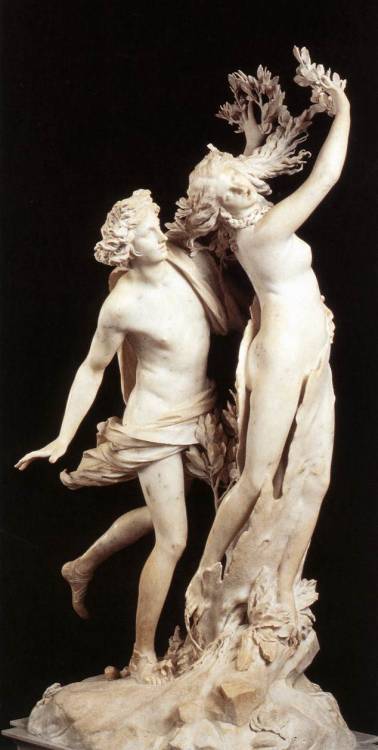
Meanwhile, the mind, from pleasures less / Withdraws into its happiness - in other words, the mind withdraws from lesser pleasures and into itself. I believe the intent here is to contrast the largely flesh-based pleasures of the world of men with the more spiritual pleasures of nature and the mind.
The mind, that ocean where each kind / Does straight its own resemblance find - I see this as an allusion to Plato's Theory of Forms.
To a green thought in a green shade - possibly the most famous line of the poem. My copy of the poem notes that the thought is likely green because it is immature and unripe, and the shade is green because it is filtered through the leaves of trees. I like this interpretation; it speaks to how solitude and nature always seem to combine to create new thoughts we could not have had if we were without either one.
And, till prepared for longer flight - my copy of the poem suggests that "longer flight" may refer to the journey to the afterlife.
Such was that happy garden-state, / While man there walked without a mate - A reference to the Garden of Eden before the Fall. I see the poem as a celebration of nature, but with a clear longing for a return to a prelapsarian state. The title clearly alludes to the Garden of Eden as well.
Where from above the milder sun / Does through a fragrant zodiac run - i.e., the sun's rays are tempered by the aroma of flora that is in the air.
Tuesday, August 23, 2011
POETRY: "Good Morning Revolution" by Langston Hughes
Alright, here is my first post on the subject of poetry. I don't really have a plan for how to approach each poem; sometimes I might be inclined to provide background or commentary, sometimes not. I may even do a spoken version on occasion (click here for some poems I've recorded in the past). Personally, I feel this is a poem that is best discovered on its own terms.
I do want to say a little bit about Langston Hughes, however (not that I know a whole lot about him). For those of you who don't know, Langston Hughes was an African-American (technically he was a mixture of a few races, but he very much identified as black) poet and one of the foremost writers of the Harlem Renaissance of the 1920s and 30s. The lion's share of his writing reflects the black way of life at that time, including the language, the struggles, and the hopes of black people in the first half of the 20th century.
It is in that section of his oeuvre that we find this poem, which is both accessible and provocative.
Good Morning Revolution
Good morning, Revolution
You're the very best friend
I ever had.
We gonna pal around together from now on.
Say, listen, Revolution:
You know, the boss where I used to work,
The guy that gimme the air to cut down expenses,
He wrote a long letter to the papers about you:
Said you was a trouble maker, a alien-enemy,
In other words a son-of-a-bitch.
He called up the police
And told 'em to watch out for a guy
Named Revolution.
You see,
The boss knows you're my friend.
He sees us hangin' out together.
He knows we're hungry, and ragged,
And ain't got a damn thing in this world--
And are gonna do something about it.
The boss's got all he needs, certainly,
Eats swell,
Owns a lotta houses,
Goes vacationin',
Breaks strikes,
Runs politics, bribes police,
Pays off congress,
And struts all over the earth--
But me, I ain't never had enough to eat.
Me, I ain't never been warm in winter.
Me, I ain't never known security--
All my life, been livin' hand to mouth,
Hand to mouth.
Listen, Revolution,
We're buddies, see--
Together,
We can take everything:
Factories, arsenals, houses, ships,
Railroads, forests, fields, orchards,
Bus lines, telegraphs, radios,
(Jesus! Raise hell with radios!)
Steel mills, coal mines, oil wells, gas,
All the tools of production,
(Great day in the morning!)
Everything--
And turn 'em over to the people who work.
Rule and run 'em for us people who work.
Boy! Them radios--
Broadcasting that very first morning to USSR:
Another member the International Soviet's done come
Greetings to the Socialist Soviet Republics
Hey you rising workers everywhere greetings--
And we'll sign it: Germany
Sign it: China
Sign it: Africa
Sign it: Poland
Sign it: Italy
Sign it: America
Sign it with my one name: Worker
On that day when no one will be hungry, cold, oppressed,
Anywhere in the world again.
That's our job!
I been starvin' too long,
Ain't you?
Let's go, Revolution!
I do want to say a little bit about Langston Hughes, however (not that I know a whole lot about him). For those of you who don't know, Langston Hughes was an African-American (technically he was a mixture of a few races, but he very much identified as black) poet and one of the foremost writers of the Harlem Renaissance of the 1920s and 30s. The lion's share of his writing reflects the black way of life at that time, including the language, the struggles, and the hopes of black people in the first half of the 20th century.
It is in that section of his oeuvre that we find this poem, which is both accessible and provocative.
Good Morning Revolution
Good morning, Revolution
You're the very best friend
I ever had.
We gonna pal around together from now on.
Say, listen, Revolution:
You know, the boss where I used to work,
The guy that gimme the air to cut down expenses,
He wrote a long letter to the papers about you:
Said you was a trouble maker, a alien-enemy,
In other words a son-of-a-bitch.
He called up the police
And told 'em to watch out for a guy
Named Revolution.
You see,
The boss knows you're my friend.
He sees us hangin' out together.
He knows we're hungry, and ragged,
And ain't got a damn thing in this world--
And are gonna do something about it.
The boss's got all he needs, certainly,
Eats swell,
Owns a lotta houses,
Goes vacationin',
Breaks strikes,
Runs politics, bribes police,
Pays off congress,
And struts all over the earth--
But me, I ain't never had enough to eat.
Me, I ain't never been warm in winter.
Me, I ain't never known security--
All my life, been livin' hand to mouth,
Hand to mouth.
Listen, Revolution,
We're buddies, see--
Together,
We can take everything:
Factories, arsenals, houses, ships,
Railroads, forests, fields, orchards,
Bus lines, telegraphs, radios,
(Jesus! Raise hell with radios!)
Steel mills, coal mines, oil wells, gas,
All the tools of production,
(Great day in the morning!)
Everything--
And turn 'em over to the people who work.
Rule and run 'em for us people who work.
Boy! Them radios--
Broadcasting that very first morning to USSR:
Another member the International Soviet's done come
Greetings to the Socialist Soviet Republics
Hey you rising workers everywhere greetings--
And we'll sign it: Germany
Sign it: China
Sign it: Africa
Sign it: Poland
Sign it: Italy
Sign it: America
Sign it with my one name: Worker
On that day when no one will be hungry, cold, oppressed,
Anywhere in the world again.
That's our job!
I been starvin' too long,
Ain't you?
Let's go, Revolution!
Subscribe to:
Posts (Atom)